

VIP System
High Rakeback
Zero-edge originals
Keno guide - lottery-style - provably fair
Number draw mechanics, RTP range, and payout structure.
Zero edge selection
Get the best possible odds by playing Keno with zero house edge
Test without risk
Try different pick counts, see how the draw plays out, and get a feel for hit frequency before putting real money on the line.
Ancient origins - modern draws
From the Great Wall of China to crypto casinos - how a number-picking game endured across centuries
Keno is a lottery-style game where you pick a set of numbers and hope that the random draw matches as many of your picks as possible. The more numbers you hit, the higher the payout. It is one of the oldest gambling formats still in active play - and one of the simplest to understand.
Legend traces Keno back to ancient China, where a similar number-drawing game called "baige piao" was allegedly used to fund the construction of the Great Wall. Whether or not the origin story is entirely accurate, the format has been part of human culture for over two thousand years. It migrated to the West with Chinese immigrants in the 19th century and eventually found its way into American casinos, state lotteries, and now online platforms.
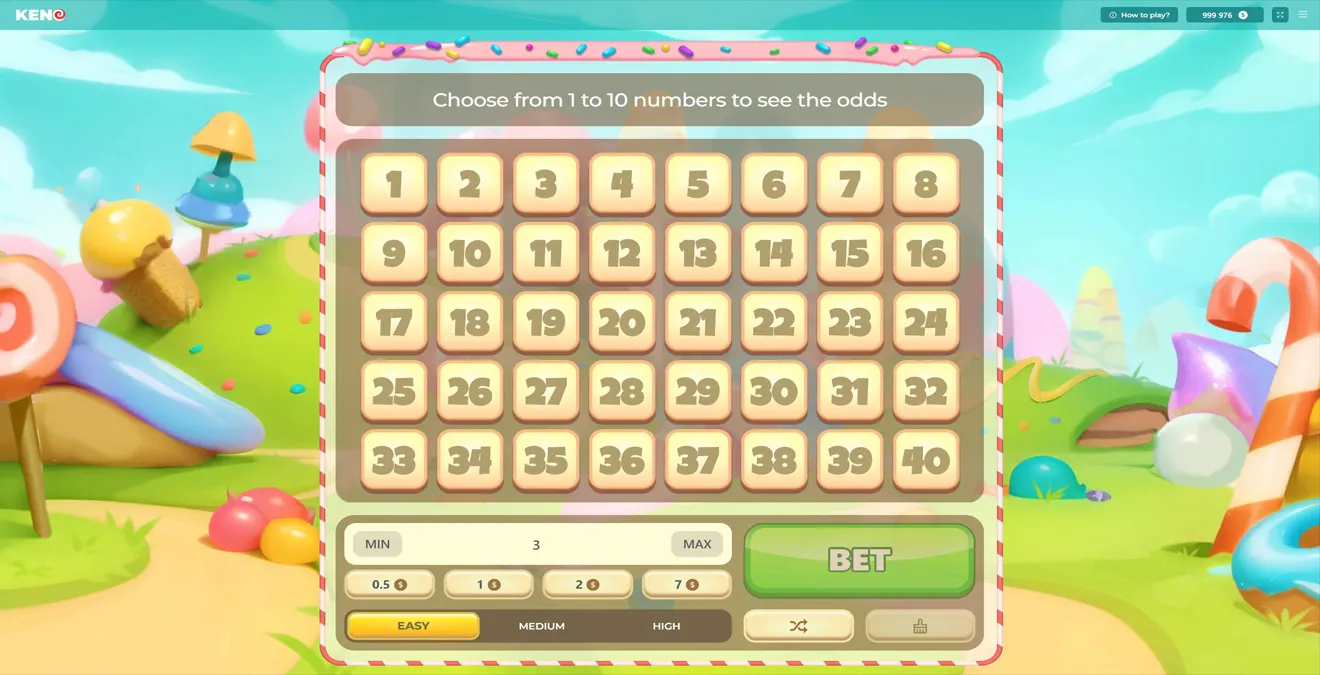
In the most common format, the game uses a pool of 40 numbers. You select between 1 and 10 numbers (called "spots" or "picks"). After you lock in your selection, the game draws 10 numbers at random. Your payout depends on how many of your picks match the drawn numbers.
The payout table is the heart of every Keno game. Picking 1 number and hitting it pays a modest amount (around 3.8x). Picking 10 numbers and hitting all 10 is astronomically unlikely but pays 10,000x or more. Between those extremes, the game offers a smooth spectrum of risk and reward based on how many spots you choose.
What makes Keno distinctive is that the player controls volatility through the number of picks. Choosing 1-3 spots creates a low-variance experience with frequent small wins. Choosing 7-10 spots turns the game into a high-volatility lottery where you miss often but can hit massive payouts when the stars align.
This is the central strategic question in Keno: how many numbers should you pick? Fewer picks mean simpler math, higher hit rates, and smaller payouts. More picks mean exponentially lower probabilities but exponentially higher rewards.
Consider the math: hitting 1 out of 1 pick has a 25% probability. Hitting 5 out of 5 has a 0.031% probability. Hitting 10 out of 10 has a probability so small it is comparable to winning a lottery jackpot. But Keno is not purely binary - you also get paid for partial hits. Hitting 5 out of 10 picks still returns a profit, and that partial-hit structure is what keeps the game playable even at high pick counts.
Most experienced players settle somewhere in the 3-5 pick range. It offers a reasonable balance between hit frequency and payout size. But the beauty of Keno is that there is no single correct answer - the optimal pick count depends entirely on what kind of session you want.
Keno is available from both traditional game studios and crypto casino originals. Stake Original and BC.Game both offer Keno with 99% RTP and a standard 40-number pool. Spribe offers Micro Keno, a faster version with lower max multipliers. Classic providers like EGT and Betsoft have their own interpretations with varying rules and payout tables.
Gamdom Keno and Duel Keno offer 100% RTP configurations, making them the best options for players who want mathematically fair payouts. Both use the standard 10-from-40 draw format with provably fair verification.
The key differences between versions come down to RTP, number pool size, maximum picks allowed, partial-hit payout tables, and whether the game supports provably fair. For pure mathematical fairness, the crypto Originals with 100% RTP are unmatched.
Game psychology
The enduring appeal of picking your own lucky numbers
Keno activates something that pure math games cannot: the feeling that your numbers are special. Even though the draw is completely random, the act of choosing specific numbers creates a personal connection to the outcome. Players have "lucky" numbers, birthday combinations, and patterns they believe in. That emotional investment makes every draw feel meaningful.
The anticipation between placing your bet and seeing the numbers drawn is uniquely powerful. Unlike Crash or Dice where the result is nearly instant, Keno gives you a few seconds of genuine suspense as numbers are revealed one by one. Each match brings a spike of excitement, and each miss brings a pang of disappointment.
The lottery comparison also helps. Keno feels more familiar than abstract crypto games because it works like something people already know. Everyone has bought a lottery ticket at some point, and Keno taps into that same hope - the dream that this time, all the numbers will line up.
A comparison of Keno games from studios and crypto originals, covering RTP, max multiplier, number pool, and pick range.
| Game | Provider | RTP | Max Multiplier | Picks | Provably Fair |
|---|---|---|---|---|---|
| Keno | Stake Original | 99% | 10,000x+ | 1-10 | Yes |
| Keno | BC.Game Original | 99% | 10,000x+ | 1-10 | Yes |
| Micro Keno | Spribe | 97% | 100x | 1-10 | Yes |
| Keno Universe | EGT | 95.46% | 10,000x | 2-10 | No |
| Keno | Betsoft | 95% | 7,500x | 1-15 | No |
| Gamdom Keno | Gamdom Original | 100% | 10,000x+ | 1-10 | Yes |
| Duel Keno | Duel Original | 100% | 10,000x+ | 1-10 | Yes |
Math & zero edge
How Gamdom and Duel built Keno where the math works entirely in your favor.
In a standard Keno game, the payout table is designed so that the expected return across all possible outcomes stays below 100%. The gap between mathematically fair payouts and actual payouts is the house edge. In classic casino Keno, this edge can be substantial - sometimes 5% or more.
A 100% RTP Keno game recalculates the payout table so that the expected value of every bet, across all possible hit combinations, equals exactly the bet amount. The draw is still random, most rounds will still miss, and big hits remain rare - but over time, the math does not favor the house.
Both Gamdom and Duel offer Keno with 100% RTP using the standard 10-from-40 draw format. Gamdom uses 99% base RTP with rakeback bringing the effective total to 100%. Duel builds the full 100% directly into the payout table with provably fair verification on every draw.
The practical impact is strongest on high-pick games (7-10 spots) where the payout table matters most. A 5% house edge on a 10,000x payout means you are missing 500x of value on every jackpot. At 100% RTP, you get the full mathematically fair payout.
In 100% RTP Keno, every payout in the table reflects the true probability of that outcome. The house draws no advantage from the math itself.
Important about zero edge
100% RTP does not mean frequent wins
Explore other original formats where operators offer zero-edge or max-RTP configurations.






Picks & patience
You cannot influence the draw, but choosing the right number of picks and managing your bankroll makes all the difference.
Keno is straightforward: pick your numbers, watch the draw, and collect if you match. But the choice of how many numbers to pick changes everything about the game.
Choose a stake that works for your session. Keno rounds are fast, and if you are playing high pick counts, you will miss more often than you hit. Size your bet accordingly.
Select between 1 and 10 numbers from the grid. Fewer picks mean higher hit probability and smaller payouts. More picks mean lower probability but much larger potential wins.
The game draws 10 numbers at random. Your matches light up as each number is revealed. This is where the suspense lives.
If enough of your picks match the drawn numbers, you win according to the payout table. Partial matches (like 3 out of 5) still pay in most versions.
After each round, you can change your numbers, adjust your pick count, or keep the same selection. Track your results and adjust your approach based on what kind of session you want.
The table below shows the probability of matching all or some of your picks in a standard Keno draw. More picks create more partial-hit combinations but make full hits exponentially rarer.
Mid-range pick counts give a balanced experience. You will hit often enough to stay engaged while getting payouts large enough to be meaningful.
Picking 10 spots is pure lottery. The full-hit probability is astronomically low. If you want to try it, use minimum bets and treat it as entertainment, not a strategy.
Not all Keno games have the same payouts for the same hits. Some reward partial matches better, others front-load value on full hits. Know what you are playing for.
Every draw is independent. The fact that 7 appeared in the last three rounds does not make it more or less likely to appear next. Pick numbers you like, not numbers you think are "due."
Keno rounds are fast and addictive, especially with auto-play. Decide how much you are willing to spend before you start and stop when you reach that limit.
The difference between 95% and 100% RTP is significant in Keno, especially on high-pick games where jackpot payouts are at stake. Gamdom and Duel offer the best mathematical deal.
Psychology of the game
Something about picking your own numbers makes every draw feel personal.
Unlike games where outcomes are purely mechanical, Keno lets you choose. That personal investment - even though it does not change the math - makes every draw feel like it matters more.
Keno delivers the thrill of a lottery draw in 10 seconds instead of days. You get the same anticipation, the same number-matching excitement, but with instant results.
Want a calm session? Pick 2 numbers. Feeling adventurous? Pick 10. Keno adapts to whatever headspace you are in, which is why it never gets stale.

Answers that matter
Common questions about Keno rules, pick strategy, hit probabilities, and where to find 100% RTP.
Keno is a lottery-style number draw game with roots in ancient China going back over 2000 years. You pick between 1 and 10 numbers from a pool of 40. The game draws 10 random numbers. Payouts depend on how many of your picks match. Unlike traditional lotteries, partial hits still pay, so matching 3 out of 5 picks returns a win.
Gamdom and Duel both offer Keno with a full 100% return to player, meaning the payout table carries zero house edge. MetaWin does not offer Keno. Standard Keno at other online casinos typically runs between 94-97% RTP, so the difference over time is substantial.
Your pick count is the single most important decision because it controls volatility. Picking 1-3 numbers gives frequent small wins with low variance. Picking 7-10 numbers creates lottery-level variance with massive multipliers but rare hits. The 4-6 range balances payout size and frequency for most players.
Yes, and this is what separates Keno from standard lotteries. If you pick 10 numbers and match 5, you still receive a payout. Even picking 8 and hitting 4 returns something. The payout table scales with both your selection size and the number of matches, so partial hits are built into the game design.
Every number has equal probability of being drawn, so no specific combination beats another. The real strategy lies in choosing how many numbers to pick. Fewer picks for grinding sessions, more picks when chasing big multipliers. At 100% RTP there is no house edge to overcome, so bankroll management becomes the primary skill.
Yes. Both Gamdom and Duel use provably fair systems. Each draw is generated from a server seed, client seed, and nonce. After the round you can verify that the result was locked before your picks, confirming no manipulation took place.
Keno traces back over 2000 years to ancient China, where a similar number-drawing game reportedly helped fund major public works. The game traveled west with Chinese immigrants in the 19th century and became a casino and lottery staple worldwide.